Let’s analyze the numbers behind the RWA Tokenization market as it is beginning to enter Phase 2, which is moving in a meaningfully different direction from the first phase.
Phase 1 was the period when the market proved that Tokenization could actually work. Most assets were U.S. Treasuries or debt instruments that offered clear returns, were easy to verify, and were trusted by institutions.
Phase 2 is the period when tokenized assets are starting to be used further in real applications. Private credit has surpassed Treasury to become the largest segment, followed by tokenized stocks growing by 422%, tokenized commodities reaching $7.3 billion, and these assets being used as collateral in the DeFi ecosystem and traded 24/7.
There is also interesting data that emerged between Phase 1 and Phase 2 of RWA, as shown in the following information.
Phase 1 (2023-2024): The Early Stage of Rapid Expansion
In Phase 1, during 2024, the tokenization market was dominated by Tokenized Treasury. BlackRock BUIDL, which launched on Ethereum in March 2024, saw its asset value rise to $500 million within just a few weeks after launch.
The numbers that best reflect Phase 1 are:
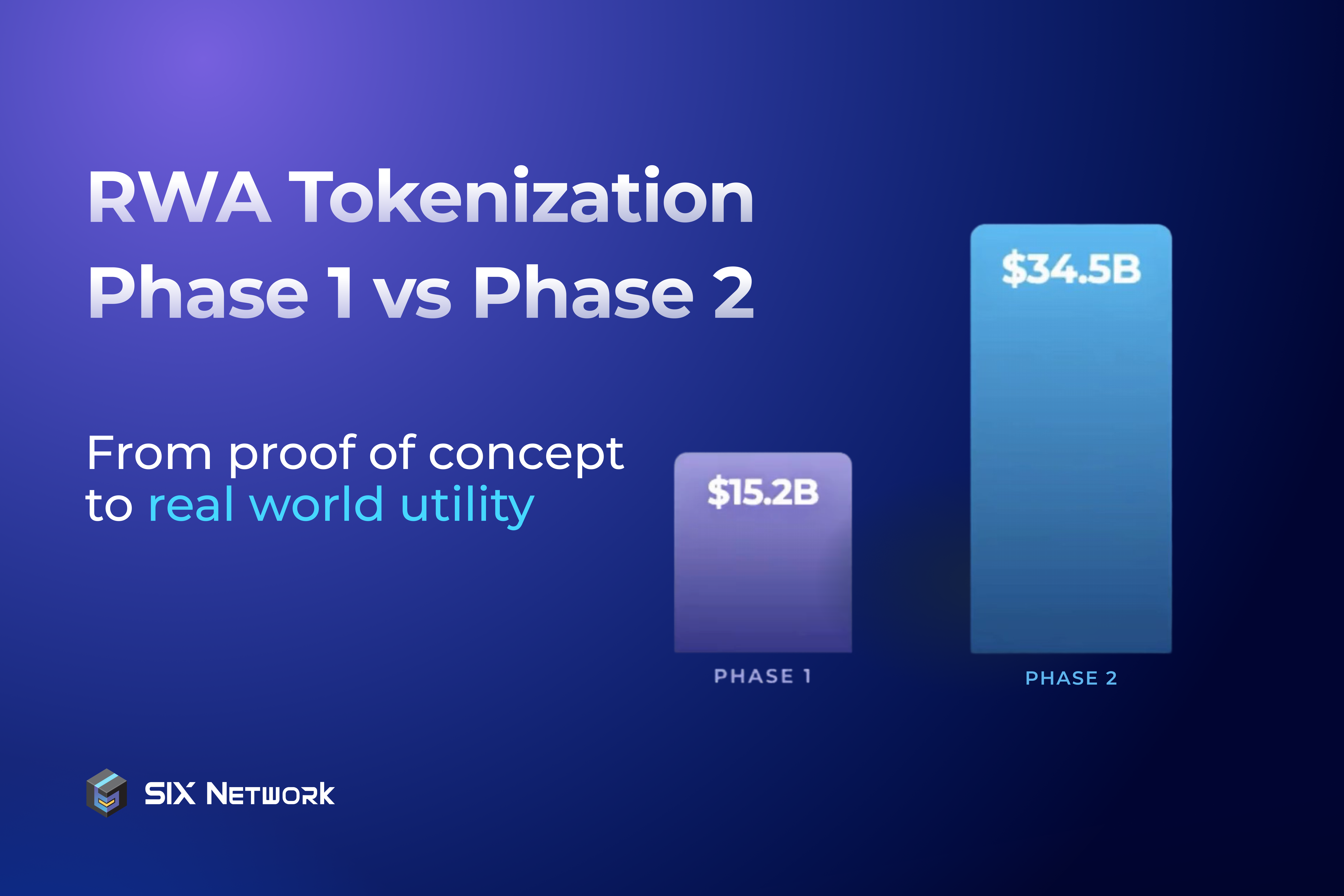
The RWA market, excluding stablecoins, expanded by as much as 85% in one year, with market value rising to $15.2 billion in December 2024. Private credit accounted for 65% of the market value, with more than 119 token issuers and as many as 81,304 token holders.
The asset class breakdown in Phase 1 clearly shows that the tokenization market was still in a testing phase, with significant room for further expansion. Treasury and money market funds accounted for 30% of total asset value in the market, while another 61% came from private credit as of early 2025. These two asset types share similar characteristics: returns that are easy to understand, clear, and lower risk.
The signal from Phase 1 was the proof that Tokenization was safe enough and could become a viable option for financial institutions to expand into and become part of digital assets.
Phase 2 (2025-Present): The Stage of Real Usage
2025 marked a turning point, as the market share of Tokenized Treasuries declined from 73.7% to only 67.2% because other asset types began catching up and receiving more support. This caused the numbers in Phase 2 to change as follows:
Tokenized commodities grew by 289%, from $1.43 billion to $5.55 billion in Q1 2026, while tokenized stocks started at $2.09 million in mid-2025 and rose to $486.69 million within the same quarter.
Private credit surpassed Treasury to become the largest segment, partly because it offered better returns than other asset types, and partly because financial institutions started using tokenized assets in more complex real-world contexts, both as collateral for transactions within the DeFi ecosystem and as flexible investment and yield-generating instruments.
A clear use case is BlackRock BUIDL, which began operating a regulated fund on Uniswap in early 2026. This opened the way for holders of tokenized bonds to use them as collateral for lending transactions, while still receiving the original returns of the token according to the holding conditions.
In addition, BlackRock brought BUIDL to be used as collateral on a digital asset trading platform such as Binance, allowing government bonds to become assets that can be used directly as collateral for trading.
This also includes J.P. Morgan, which built its own platform called Onyx, enabling bond trading to happen in real time with a working model similar to crypto.
What the Data Shows When Comparing Both Phases
If we compare Phase 1 and Phase 2 through numbers and behavior:
Phase 1 had as many as 81,304 token holders in 2024. Market value was dominated by Treasury and private credit because both were asset types with qualities that were “explainable and easy to understand,” suitable for institutions, and most use cases stopped at holding assets to receive returns in a straightforward way.
Phase 2 had 65,729 holders of Tokenized Treasury alone in Q1 2026, with more diverse types of digital assets. Commodities grew to nearly three times the size of equities, and what changed beyond the numbers is that tokenized assets are beginning to be used further within the new financial system, both as collateral for trading on Decentralized Exchanges (DEXs) and integrated with DeFi protocols that support this type of usage.
Where Phase 2 Is Heading Next
Based on the data we are seeing now, Phase 2 of tokenization has not yet reached its peak. There are also three clear directions that are likely to happen next.
More diverse asset classes – Tokenized real estate, equities, and commodities beyond gold are still in the early stage. The numbers from Phase 1 indicate that treasury was only the starting point, not the destination.
More complex utility – BUIDL starting to trade on Uniswap is a signal that tokenized assets are entering the DeFi ecosystem more seriously. The next direction is for tokenized assets to be used more in structured products and lending protocols.
Geographic expansion – In 2024-2025, the tokenization market was concentrated in the United States and Europe. In Phase 2, the market is expanding into other regions. Banks in Asia and Central and South America are beginning to issue tokenized instruments on public networks, and regional infrastructure such as SIX Protocol is what allows assets in Southeast Asia to enter this system.
All of this indicates that Phase 2 is not just Phase 1 becoming larger. Tokenization is becoming one of the infrastructures of the financial system and developing into use cases that allow us to see RWA adoption this year.