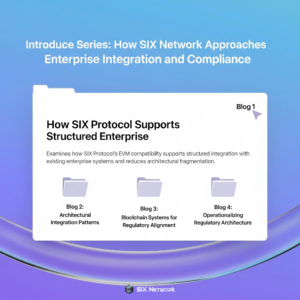
Enter to Blog 3: How Blockchain Architecture Can Be Built for Compliance and Regulatory
Compliance concerns often surface early in blockchain discussions. Questions about immutability, data protection, and auditability frequently delay adoption decisions.
However, many compliance challenges arise not from blockchain itself, but from incomplete architectural design. Regulatory alignment is rarely achieved through features alone. It requires deliberate system partitioning and governance modeling.
This article explores how compliance can be approached as an architectural principle rather than a reactive requirement.
Separation of On-Chain and Off-Chain Data
One of the most common misconceptions is that all operational data must reside on-chain. In regulated environments, this is rarely appropriate.
A structured architecture typically separates:
• Transaction proofs and hashes (on-chain)
• Sensitive or personal data (off-chain, within controlled databases)
Blockchain functions as an integrity and verification layer rather than a primary data repository.
SIX Protocol can support this model because it does not impose a rigid data storage architecture. Organizations retain flexibility in determining what information is recorded on-chain.
Permissioned Control and Identity Mapping
Regulatory frameworks often require clear attribution of actions. This means system architecture must map enterprise identity management systems to blockchain-level roles.
Permissioned models allow organizations to define who can initiate, approve, or view specific transactions. However, identity verification and access governance remain enterprise responsibilities.
SIX Protocol’s permission structures and traceable transaction metadata can support this alignment, but compliance ultimately depends on governance processes and audit design.
Auditability Without Overexposure
Another common concern involves transparency. Public blockchains expose transaction data broadly, which may conflict with confidentiality requirements.
Architectural strategies such as encryption, role-based access control, and metadata minimization allow organizations to maintain auditability without disclosing unnecessary information.
The objective is controlled transparency, providing regulators and auditors with verifiable records while limiting exposure of sensitive business data.
Complete Your Design Blockchain Systems
Compliance should not be treated as a secondary checklist applied after system deployment. It must inform architectural decisions from the beginning.
SIX Protocol provides technical capabilities, permission models, traceability, and integration flexibility that can support compliance-oriented design. However, regulatory alignment is achieved through thoughtful system architecture and operational governance.
In the final article, we explore practical considerations for moving from compliance design principles to operational deployment.
────────────────────────────────────
Learn more about SIX Network
Website l Telegram l Twitter l Facebook l Discord l Medium