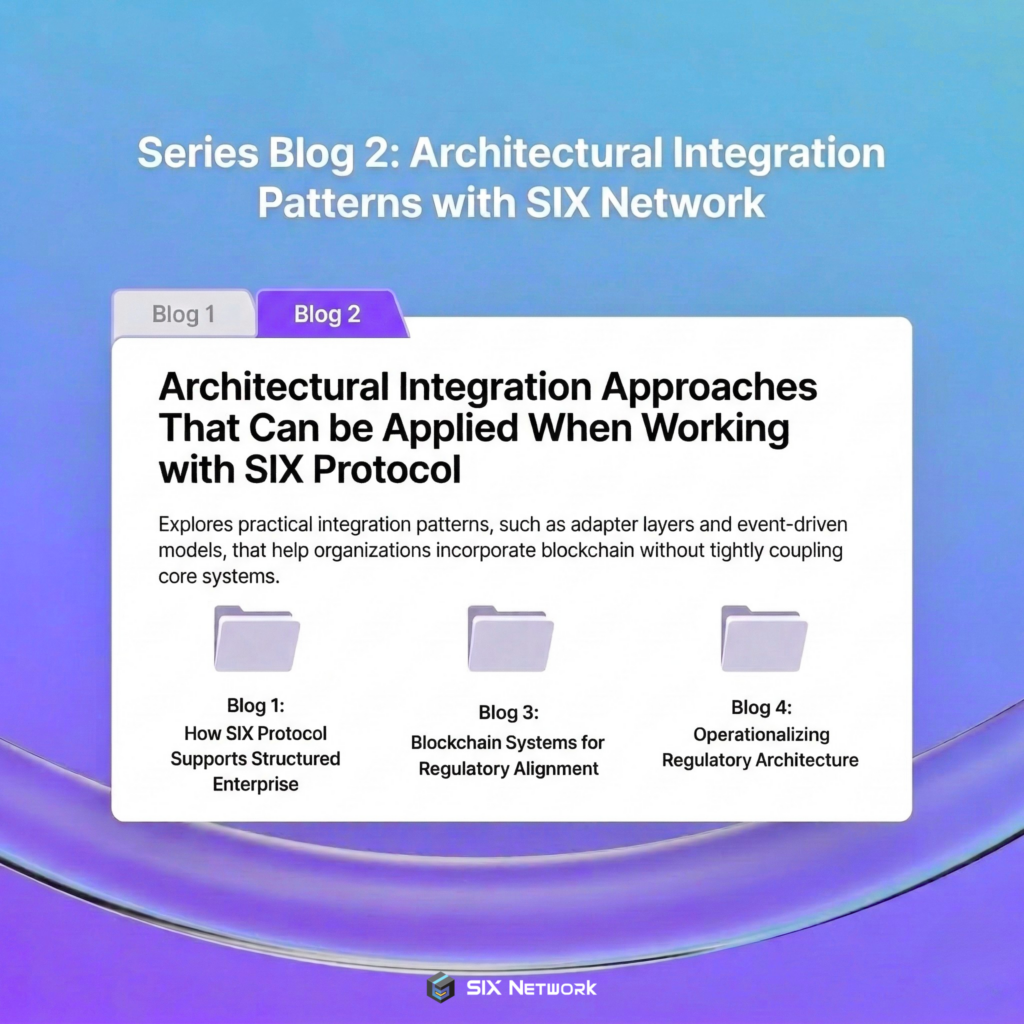
Enter to Blog 2: Architectural Integration Patterns with SIX Network
In the previous article, we discussed how standards alignment, particularly EVM compatibility, reduces friction during enterprise blockchain adoption. However, compatibility alone does not solve integration complexity. What determines long-term success is architectural discipline.
Enterprise blockchain integration should not be treated as a feature implementation. It is an architectural extension of the existing system landscape. Without clear boundaries and integration patterns, blockchain components risk becoming tightly coupled to core systems, increasing operational risk and long-term maintenance cost.
This article examines architectural integration approaches that can be applied when working with SIX Protocol.
The Adapter Layer as an Architectural Boundary
One of the most reliable integration strategies in enterprise environments is the introduction of an adapter or middleware layer between core systems and blockchain infrastructure.
Instead of allowing ERP or CRM systems to directly interact with smart contracts, a controlled integration layer handles:
• Data transformation
• Transaction creation
• Signing and authorization
• Error handling and retry logic
This separation ensures that blockchain-specific concerns remain isolated. Core enterprise systems continue operating using their existing data models and workflows.
SIX Protocol’s standards-based execution environment allows this boundary to be implemented without proprietary constraints. Because it follows EVM standards, integration layers can leverage widely available libraries and established development patterns.
The objective is not simplification through abstraction alone, but architectural containment. Blockchain logic becomes a replaceable or evolvable component rather than a deeply embedded dependency.
Event-Driven Recording Without System Disruption
Many enterprise systems already rely on event-driven architectures. In such environments, blockchain should function as a recording or verification layer triggered by specific business events, rather than as the primary transaction processor.
For example, when an order is finalized or a compliance approval is completed, an event can be emitted internally. A blockchain integration service listens to these events and records relevant transaction metadata onchain.
This approach provides traceability without requiring the core business system to be redesigned. It also reduces operational risk, as business continuity does not depend on blockchain availability.
SIX Protocol supports this model because it does not require tightly coupled execution patterns. It can function as an external integrity layer that complements existing workflows.
Designing for Governance and Observability
Enterprise architects must consider governance and monitoring from the beginning. Blockchain components should integrate into existing operational monitoring frameworks rather than exist as isolated infrastructure.
Key architectural considerations typically include:
• How transaction states are monitored
• How failures are surfaced to operations teams
• How audit logs are correlated across systems
• How identity and permission models map between enterprise systems and blockchain roles
SIX Protocol’s permission capabilities and transaction traceability can support governance design, but they do not replace it. Governance remains an architectural responsibility.
Key Takeaway
Successful blockchain integration is less about adding distributed infrastructure and more about disciplined system design. Adapter layers, event-driven recording, and governance mapping are architectural tools, not product features.
SIX Network’s design choices allow these architectural strategies to be applied without introducing proprietary execution models or isolated tooling stacks.
In the next article, we shift focus from integration patterns to regulatory architecture and compliance-oriented design.
────────────────────────────────────
Learn more about SIX Network
Website l Telegram l Twitter l Facebook l Discord l Medium